
Is Thanksgiving being rewritten?
I was reading B is for Buckeye by Marcia Schonberg to my daughter at six in the morning while drinking my coffee. It is a little book that teaches the alphabet to children while also teaching them Ohio history and facts. It shows them that they can be proud of their state and where they come from. (Never mind the fact that we live in Wisconsin.) We read about John Glenn, Oliver Hazard Perry, John Chapman (Johnny Appleseed), and why Ohio is named the Buckeye State.
I couldn’t help but think about how much history is often forgotten with each new generation and how much I learned from a children’s book. I started to think of many other aspects of not just American life but history pertaining to Ohio (where I grew up) that has been forgotten. How many traditions have died because they simply were not taught. Or worse, how many traditions have died because they were rejected by the younger generation or rewritten to mean something else. Traditions have a way of preserving history and history provides us with Identity. If history is erased, so can a tradition and if tradition is erased, so can a culture.

Thanksgiving is a perfect example of this history and tradition being rewrote. I like to revisit the original story every year and read the original records since any blog post written today is usually a copy and paste of a different blog post's negative view of Thanksgiving. These blogs usually are titled something like, "The true story of Thanksgiving." It usually goes along the lines of the white man committing genocide of the native tribes and taking advantage of the native peoples. I don't know why this must be perpetuated as the "true" history of Thanksgiving when it has nothing to do with Thanksgiving and simply keeps a grudge alive. I want to point out the truth of why Thanksgiving is celebrated and what Thanksgiving is supposed to mean. Along with some of the other ridiculous claims about one of our treasured holidays. I think you will find that sometimes the truth is better told by tradition than it is by historians or organizations who have a narrative to accomplish.
Where do we get the facts from? The primary source records that best describes the first Thanksgiving were written by William Bradford and Edward Winslow. Winslow (the more detailed record) describes a three-day feast in which 52 Pilgrims, along with about 90 Wampanoag Indians takes place. Bradford describes the feast/harvest as small and makes no real special note of it in his history of Plymouth Plantation however there is one detail that is of some importance which we will cover soon. But we can deduce that he is talking about Thanksgiving because of how it correlates with Edward Winslow's record of Thanksgiving.
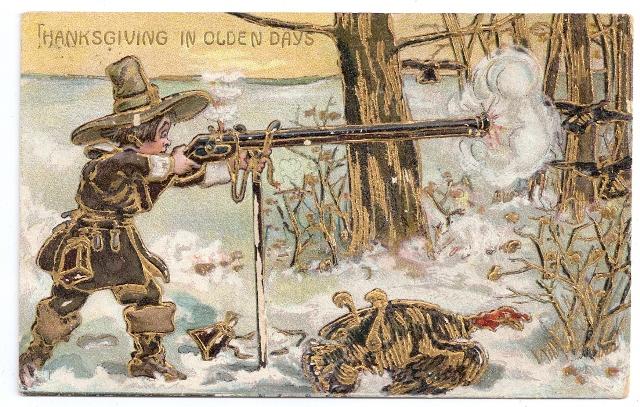
Myth: the Pilgrims did not have turkey on Thanksgiving.
I attended public school and we were actually taught that the Pilgrims did not eat turkey because, “It probably wasn’t available to them.” Even an AI overview on Google will give you this narrative along with many blogs that often copy and paste what the author read on a different blog.
The Truth? All of this is a lie and utter nonsense. William Bradford's account is where we get the Thanksgiving turkey. In both accounts we see how a hunting party was sent out to kill "fowl" in which the party killed enough to feed the entire colony but we also see something specifically mentioned in Bradford’s account. We see that these fowl also included “a great store of wild turkey.”[4] Aside from the mention of turkey by Bradford, simple logic teaches us that wild turkey was abundant at the time, making it a silly claim that turkey was not among the food which the colonists had available. Among fowl and turkey plenty of other food was had. Thanks to the natives crops like, corn, barley and squash were had along with five deer.
Myth: Thanksgiving is not a religious holiday.
Again, I will mention that I went to public school. God was mentioned very little when talking about Thanksgiving. One could argue that omitting some facts is not a lie. I would argue that omitting the most important fact - the fact that Thanksgiving was a religious festival of thankfulness - is not only a lie but leads people astray in the most important aspect of life: their spiritual life and heritage. It deprives them of identity. And it deprives their Thanksgiving celebration of all meaning.
The Truth: The truth is the Pilgrims were deeply religious and gave thanks to the Lord that they had a bountiful harvest due to the native Squanto. But to whom did they give thanks? It was not uncommon that days of thanksgiving were proclaimed by the Pilgrims; however, a day of thanksgiving in those days was often a solemn day to the Lord and they were not annual feasts like our modern day Thanksgiving. Instead they were designated as thought appropriate. However each Thanksgiving that was declared was religious in origin. The 1621 account of Thanksgiving seems to be missing any written record of a proclamation of thanksgiving but the 1623 account was a formal day dedicated to the Lord. Whether is was a formal proclamation or not in 1621, it would be reasonable to assume that the 1621 Thanksgiving was filled with prayer, Bible readings, and worship simply because of the customs that the Pilgrims held. If the 1621 Thanksgiving was not considered religious, then the 1623 Thanksgiving was. Both of these days give us the basis of why we celebrate Thanksgiving. The Pilgrims would continue their tradition of declaring thanksgivings when deemed appropriate, a tradition that even presidents held until Abraham Lincoln made it an annual celebration in 1863 to give thanks to the source of where our provisions come from.
"I do therefore, invite my fellow citizens in every part of the United States, and those who are at sea, and those who are sojourning in foreign lands, to set apart and observe the last Thursday of November as a day of thanksgiving and praise to our Father who dwelleth in the heavens."- Abraham Lincoln's Thanksgiving day Proclamation (Oct 3, 1863).
Myth: the Thanksgiving story is filled with cruelty and genocide against the natives.
This myth is a large and nonspecific myth that is more of a narrative covering several hundred years of history rather than the story of the first Thanksgiving. The myth goes along the lines that the natives were treated unjustly, were subject to disease, and were hunted and killed by the hands of the white man. Although this could be considered true if we were talking about the Indian wars following the forming of the United States or Cortez and his attack on the Aztec Empire, it is false in the narrative of Thanksgiving. The original Thanksgiving stories are ones of peace and friendship, not of war and disease.
It is important to understand that each native tribe was a separate culture and nation just like how each English colony was governed separately. It would be foolish to lump all Native Americans into one culture, just like it would be foolish to lump all Europeans into one culture (even though this is exactly how politics work). The Pilgrims and the Wampanoag tribe (not other native tribes) held the "Mutual Peace and Protection treaty of 1621" for over 50 years. That is 50 years of peace between the Pilgrims and the Wampanoag people. It wasn't until Chief Massasoit's death where things started to deteriorate. To think that any conflict that happened after those 50 years should be viewed as "The Thanksgiving story" is ignoring the good. These narratives tend to point toward conflicts that happen either long before the Pilgrims with other white settlers or after the treaty dissolved, meaning that these stories are not the story of Thanksgiving but a different story.
How to Celebrate?

Now that the facts are settled, I want to move to what this means. The tradition, not AI overview and public-school teachers, is where the truth is. I make my family watch A Charlie Brown Thanksgiving every year because it tells a very accurate story of the first Thanksgiving. It is sad when Charlie Brown is a better history teacher than our public school systems. I think that keeping to tradition is a good way to celebrate; but the most important aspect, the one that gives it meaning, is to keep it as a day unto the Lord. However you do that is up to you, but there are some traditional methods of celebrating.
Hunting
There is a long tradition of hunting on Thanksgiving morning here in the Midwest, which was inevitably carried down over the centuries. It is a great way for fathers and sons to connect and be apart of creation while also acting out the Thanksgiving story, even if they don't know it.
Sports
One tradition that I recently have come upon is the Pilgrims’ participation in sports and games on this day. I have encountered many people who claim that football is not worth watching on Thanksgiving in an effort to over-spiritualize the day. I want to point out the original celebration did include playing sports, and “exercising their arms”[5] meaning shooting their guns. My point is that historically speaking, sports is as much of a way to celebrate as is hunting, singing songs to the Lord, or praying before the actual dinner.
Feasting/ Fasting
Aren't these two opposites? Yes, but the 1623 account of Thanksgiving was different in that the Pilgrims fasted and worshiped God that He would send rain on their crop. When the rain came, the Pilgrims celebrated, proclaimed a day of Thanksgiving, and then feasted.
Prayer/ Worship
Don't forget why Thanksgivings were declared in the first place. It gives the day its meaning. Pray, read scripture, sing songs, whatever brings glory to God.
Learning the History
Again, I make my family watch the Charlie Brown version, but you can read the original accounts, Lincoln's proclamation, or a poem about the day. Keeping the history in mind is important to our culture.
Conclusion:
Historians, writers, and bloggers like to cast a shadow on the Thanksgiving story by highlighting the bad parts of history that happened long after or long before. Thanksgiving, though, does not celebrate the bad parts of history; it celebrates the good. It is true that Squanto was a captive and taken to England. That is where he learned English. However, Squanto did not hold his captivity against the Pilgrims; instead he saw the Pilgrims very different from his captors and he aided them. Thanksgiving offers us a time in which the natives and Pilgrims saw eye-to-eye.
It is interesting how Thanksgiving paints a perfect picture of how history can be erased and rewritten, but the truth can be hidden in the traditions we hold. The traditions hold our history, our culture, and our way of life. The records of the first Thanksgiving (1621 & 1623) should be revisited. It gives us examples of how to celebrate and what these celebrations meant. I don’t want to tell everyone how they should celebrate their Thanksgiving, but I do want to point out the facts about Thanksgiving and what it means. I encourage tradition (of course); history and tradition provide us with roots and meaning.
Links to Primary Source Documents of the First Thanksgiving.
https://mayflowerhistory.com/letter-winslow-1621
https://ia801308.us.archive.org/5/items/cu31924028814824/cu31924028814824.pdf
Images:
J.L.G Ferris. "The First Thanksgiving 1621" The Foundation Press 1932. Library of Congress.