
A Short History of Hunting in America.
It can be said that America was founded upon the pelts of animals as much as it was founded on the spread of the gospel. Since the founding of Jamestown in 1607 or the Plymouth Colony in 1620 American settlers have hunted North America's game animals as a way of survival, for sport, or as a way to make their livelihood. The colonists would trade peltry with natives for European markets. Items like deerskin pants, gloves, blankets from the American buffalo, or the most sought after item, beaver hats, were just a few commodities that the colonists and Europeans desired. When the explorers first arrived many of the their journals and diaries refer to the vast amounts of wildlife on the continent and mention of beaver was not unusual. Europe had mostly cleaned out their beaver population and when a new market in America opened up, fur companies funded settlers to go to America.

When these European pilgrims settled on the North American coast they were met with a harsh reality, they had to learn how to survive in a new climate. Part of this story of survival is where we get our precious holiday of Thanksgiving. The pilgrims had to learn how to hunt on this new continent to survive but they also had to pay their investors in fur, particularly beaver. Little actual trapping was done by European settlers in the early days of colonial America. The hunting and trapping was left up to the Native Americans, who were experts in their craft. As the colonies grew, market hunting (hunting for money) became a larger industry, so large that companies like the Hudson Bay Company had an entire monopoly over 70% of Canada. In fact, the market over animal furs became so large that most of the early conflicts between native tribes and European powers were largely over hunting and trapping lands.
The not so famous Beaver Wars are some of the earliest conflicts in which the Iroquois Confederacy had trapped out many of the fur bearing animals in their original lands and launched attacks into new lands and pushed out other native tribes. These beaver wars lasted for almost a century and contributed to a mass migration of many tribes to the Ohio Valley where they would take up new homes. Over time as the English colonies grew and the need for a new source of furs arose the white settlers pushed into the Ohio Valley which was a highly contested area between the French fur traders and the English. The Ohio Valley was not a well defined area but was rather loosely based on the Ohio river drainage system and would include parts of Pennsylvania and Kentucky. This dispute over the region eventually gave rise to what we call the French and Indian War, or the Seven Years War.
After the Treaty of Paris in 1763, much of the French land including the Ohio River Valley all the way to the Mississippi were ceded to England. In the first of Steve Rinella's newest book series The Long Hunters he writes about how this period marks when a flood of hunters set out to explore west of the Appalachians. This period also sees an increase conflict with native Americans. Men like Daniel Boone moved onto what was considered native lands and took up the trade of hunting and trapping for themselves instead of trading with the natives.
After the American Revolution the American Fur Company ran by a man named Jacob Astor started in the Northwest states (What is now Ohio, Indiana, Michigan, Illinois, Wisconsin and Parts of Minnesota.) These areas continued to be a large source for beaver, otter and deer. It was a frontier at this time, and a frontier in which the British still had many garrisons in the territory which would eventually be one of the causes for the War of 1812. The American fur company saw large profits but just like the east coast, the Northwest, now known as the Old Northwest, saw a decline in beaver, otter, and other fur bearing animals.
As America expanded west Astor saw opportunity in the Pacific Northwest. Astor had many fur traders under his employment and became the largest fur trading enterprise in the country. "The Mountain Man Era" the period from directly after the Lewis and Clark expedition in 1806 is the most famous of all the eras in American hunting history. It is the earliest stories of the wild west and feature men such as Jim Bridger, John Johnston, Hugh Glass, John Colter, and Jedediah Smith. These men, like many who proceeded them were mainly after beaver hidden within the Rocky Mountains. The Mountain Man Era came to a close when the beaver skins were no longer desirable as in centuries past because new silk hats were in style in Europe and the beaver numbers were dwindling.
With beavers gone. Buffalo were the next target for hunters. When Americans first arrived
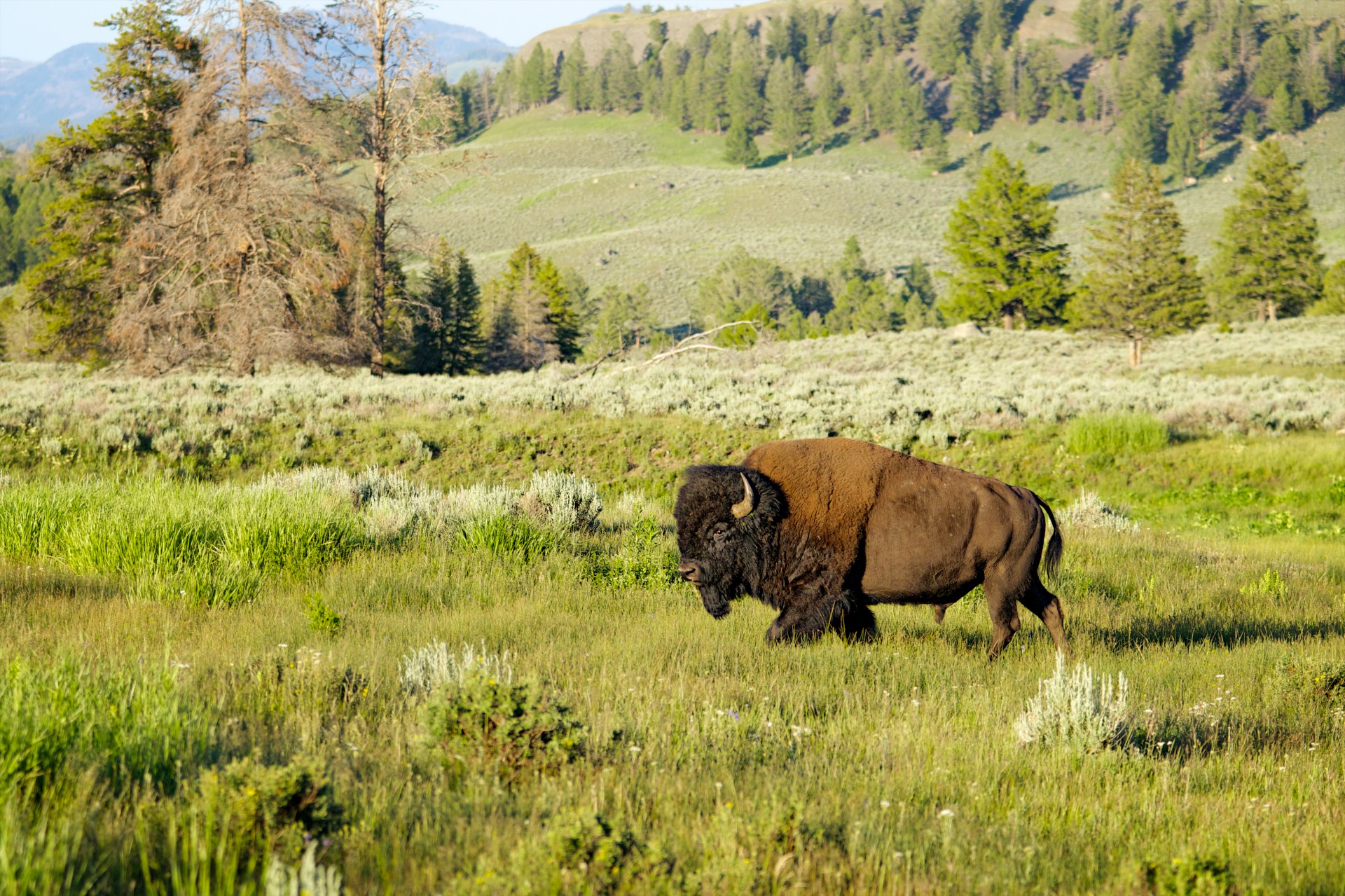
on the continent the buffalo herds stretched from Pennsylvania to the mountains in the west and beyond. (Daniel Boone notes buffalo during his explorations of the Blue Grass state.) By the time the buffalo hunters came along, the herd had been reduced to the central plains. Shortly after the American Civil War, buffalo hunters nearly killed enough buffalo to make the animal go extinct. However, this is also the period where conservation in America really starts to take its root.
Toward the end of the 19th century when the buffalo were all but wiped out, elk had been chased into the mountains and the beaver reduced to fragments of it's original territory, Men like Richard Gifford and Theodore Roosevelt start to embrace conservation. Americans started to view the wildlife within its borders as a natural resource and men like these wanted to conserve the resource for future generations to use. Massive chunks of land such as Yellowstone had already been placed aside as national parks but it was Theodore Roosevelt who became famous for increasing the amount of land and structuring how America does conservation. Market hunting, the type of hunting that reduced many species to almost nothing was gutted with the "Lacy Act of 1900" and the "Migratory Bird Treaty Act of 1918." Market hunting was unsustainable and something had to be done.
By the end of the 19th century America's hunting culture started to take on a new shape. With farmland developed and the cattle industry booming Americans did not need to hunt to survive. Hunting is now reserved as mostly a hobby. Earnings from trapping are very little and the hours spent in the woods typically do not outweigh the benefits of a regular

job as it did in days past. However, hunting still plays an important part in American culture. Hunting, leads the way in conservation efforts. It also is a way for men to build character, learn new skills and connect with God's creation around them. From the first settlers to natives that proceeded them, hunting in America has been truly unique and it is built into the bones of America.
References and For Further Reading
Ken Kistler. "Profile of a Buffalo" publicdomainimage.net.
Rinella, Steve & Newcomb. (2024.) MeatEater's American History: The Long Hunters (1761-1775) NY. Penguin Random House.
Rinella, Steve & Newcomb. (2024.) MeatEater's American History: The Mountain Men 1806-1840. NY. Penguin Random house.
Rinella, Steve. (2019) American Buffalo: In Search of A Lost Icon. NY. Penguin Random house.
Note* Old Northwest Leather LLC participates as an Amazon affiliate.